Bell’s Palsy and stroke face classification using SVM with MediaPipe Face Mesh
Keywords:
Bell's Palsy, Facial Asymmetry, machine learning, MediaPipe Face Mesh, stroke, Support Vector MachineAbstract
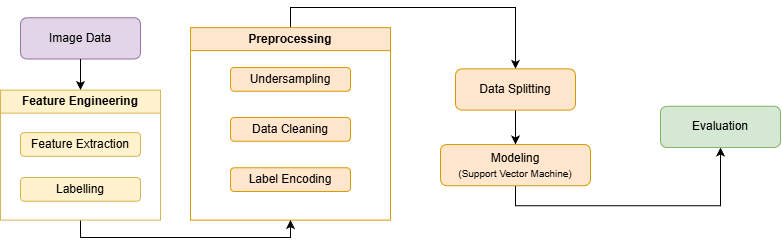
Stroke and Bell’s Palsy share similar manifestations of unilateral facial paralysis, often leading to clinical misinterpretation, particularly in acute cases. Although deep learning approaches have demonstrated strong performance in segmenting facial paralysis regions, these methods primarily focus on area localization rather than directly differentiating Stroke and Bell’s Palsy, and typically require large-scale datasets and substantial computational resources. To address this gap, this study proposes an explainable and resource-efficient framework for classifying Stroke and Bell’s Palsy using asymmetric facial numeric features extracted from static images. Unlike appearance-based deep learning models, the proposed approach transforms facial landmarks detected by MediaPipe Face Mesh into geometric asymmetry features through Min–Max scaling, Euclidean distance, and angle computation. After class balancing via undersampling, classification was performed using an SVM with an RBF kernel. The 70:30 split achieved the most stable performance, with a testing accuracy of 0.8041 and cross-validation accuracy of 0.8072 ± 0.0069, indicating minimal generalization gap. These findings demonstrate that geometric asymmetry features combined with SVM provide a reliable and interpretable alternative for differentiating BP and ST under limited data and computational constraints.
Downloads