User experience testing on Smart Human Capital Dashboard (SHUCADA) from PT Studio Kami Mandiri using User Experience Questionnaire (UEQ)
Keywords:
Data analysis, user experience questionnaire, user experience testingAbstract
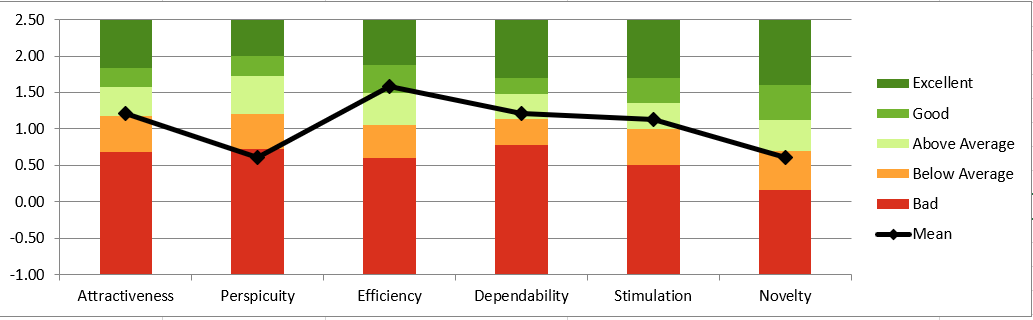
PT Studio Kami Mandiri is a company specialized in software development. PT Studio Kami Mandiri has developed several products or applications that have also been used by large companies. One of the products developed is the Smart Human Capital Dashboard (SHUCADA) which is used to monitor the performance of an employee in a company. User experience testing is needed to find out the possible obstacles that users will face when using the application. Therefore, this research conducted user experience testing on SHUCADA to find out employee perceptions of the application. User Experience Testing of SHUCADA using the User Experience Questionnaire (UEQ) Data Analysis Tool found that aspects of attractiveness with mean value 1.21, dependability with mean value 1.208, and stimulation with mean value 1.125 get above average scores, and aspects of efficiency (mean 1.583) get good scores. The perspicuity aspect (mean 0.604) received a bad score and the novelty aspect (mean 0.604) received a below average score.
Downloads